Energy & Utilities
Why Are Your Customers Still Calling?
Why Are Your Customers Still Calling? The Case for Segmented Utility Communications
Most utility customers aren't calling because they enjoy it. They're calling because no one told them what was happening — and the digital experience they turned to first gave them nothing useful.
Utilities are consistently among the most call-intensive and queue-challenged industries in the country. The assumption is often that this is inevitable — that outages will always generate calls, that billing complexity will always require human intervention, that some customers will always prefer the phone. There's partial truth in all of that. But it misses the more important point: a significant share of utility call volume is predictable, preventable, and directly connected to the quality of proactive digital communications an organization sends before a customer ever picks up the phone.
We've been building those communications for a leading California investor-owned utility. The scope: more than 120 email campaigns built in Salesforce Marketing Cloud, reaching millions of Californians with personalized communications on energy choices, wildfire preparedness, and outage readiness. What we've learned in that work shapes how we think about utility customer communications more broadly.
Key Takeaways
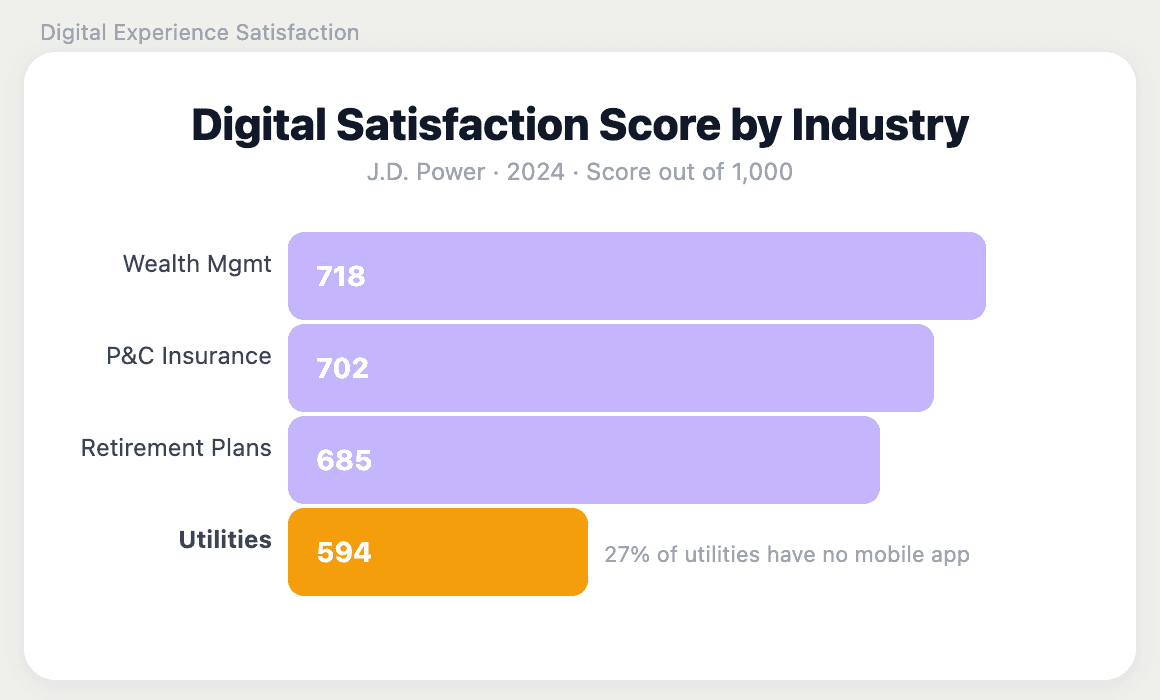
In 2024, utility digital experience satisfaction scored just 594 out of 1,000 on J.D. Power's scale — the lowest of any major financial services or utilities category studied (J.D. Power, 2024)
Utilities that provide timely outage information score 52 points higher on customer satisfaction than those that don't (J.D. Power, via Questline Digital, 2024)
Proactive outage communications reduce inbound complaint call volumes by up to 60%, according to industry deployment data (SilverBlaze/DataHorizon, 2024)
In California, a single November 2024 PSPS event de-energized 71,044 SCE customers — and generic communications in that context aren't just a CX failure, they're a public safety failure (CPUC, 2024)
Utility Digital Experience Has a Satisfaction Problem
In 2024, overall utility residential customer satisfaction declined for the fourth consecutive year, reaching 707 out of 1,000 in J.D. Power's annual study — with billing and customer care posting the steepest drops (J.D. Power, 2024 U.S. Electric Utility Residential Customer Satisfaction Study, n=107,175 respondents, 151 utility brands). On the digital experience side, utilities scored 594 out of 1,000 — significantly below wealth management apps (718), property and casualty insurance (702), and retirement plans (685). Notably, 27% of utilities still don't offer a mobile app.
That number matters for a specific reason: when digital experience is poor, customers default to a more expensive channel. They call.
The relationship between digital quality and inbound call volume is more direct than most utility leaders account for. Industry deployment data suggests that proactive outage communications — the kind that reach customers before they start searching for answers — can reduce complaint call volumes by up to 60% during outage events (SilverBlaze, citing DataHorizon research, 2024). One KUBRA utility client saw an 18% reduction in inbound calls after implementing more proactive outage communication workflows, combined with a 77% increase in the volume of proactive notifications sent.
The inverse is also true: when customers aren't told what's happening, they find out by calling. Many times.
In California, Generic Communications Carry a Different Kind of Risk
Wildfire season, heat events, and grid stress are no longer seasonal concerns for California utilities — they're year-round operational realities. Public Safety Power Shutoff (PSPS) events, in which utilities proactively de-energise circuits to prevent ignition in high-risk weather conditions, have become a fixture of California life.
In November 2024 alone, SCE triggered a PSPS event that de-energized 71,044 customers across eight counties in a single action. The following month, a wind event simultaneously de-energized 51,105 SCE customers and 51,922 SDG&E customers (CPUC Post-Event Reports, 2024).
These aren't routine outages. A customer losing power because of planned grid maintenance needs information. A family in a high fire-risk zone losing power during a PSPS event — possibly with medical equipment, refrigerated medication, or elderly dependants in the household — needs a completely different communication. The timing is different. The content is different. The call to action is different.
The stakes shift when communications fail: A generic mass email sent 24 hours before a PSPS event might tell a residential customer their power will be out. It won't tell the small business owner which tariff provisions apply, what backup resources are available, or how to file for interruption credits. And it won't tell the family in a designated High Fire-Risk Zone what SCE's medical baseline program covers or where their nearest Community Resource Centers is. Same send. Three customers who needed three different messages. One of them — statistically — wasn't ready when it mattered.
SCE's grid hardening program is currently targeting 80,000 customers in high fire-risk zones across 60+ communities, with a projected 78% reduction in PSPS exposure for the most-impacted circuits (Energized by Edison, SCE, 2023). The infrastructure investment is significant. But the communications layer — what customers receive, when, and in what form — is what determines whether that investment translates into trust, or whether it lands as another mass notification that felt like it was written for someone else.
What Proactive Communications Actually Change
In 2024, Questline Digital's utility email benchmarks found that outage-related emails achieve a 31.4% open rate — the second-highest category in utility email performance, behind only welcome series (Questline Digital, 2024). Separately, 82% of utility customers say they prefer proactive communications during an outage over finding out through other means.
That 31.4% figure deserves some context. The average email marketing open rate across industries sits around 21%. Outage communications outperform that baseline by nearly 50% — because customers are actively looking for that information. The opportunity isn't getting people to care about the message. It's delivering the right message before they've had to go looking for it themselves.
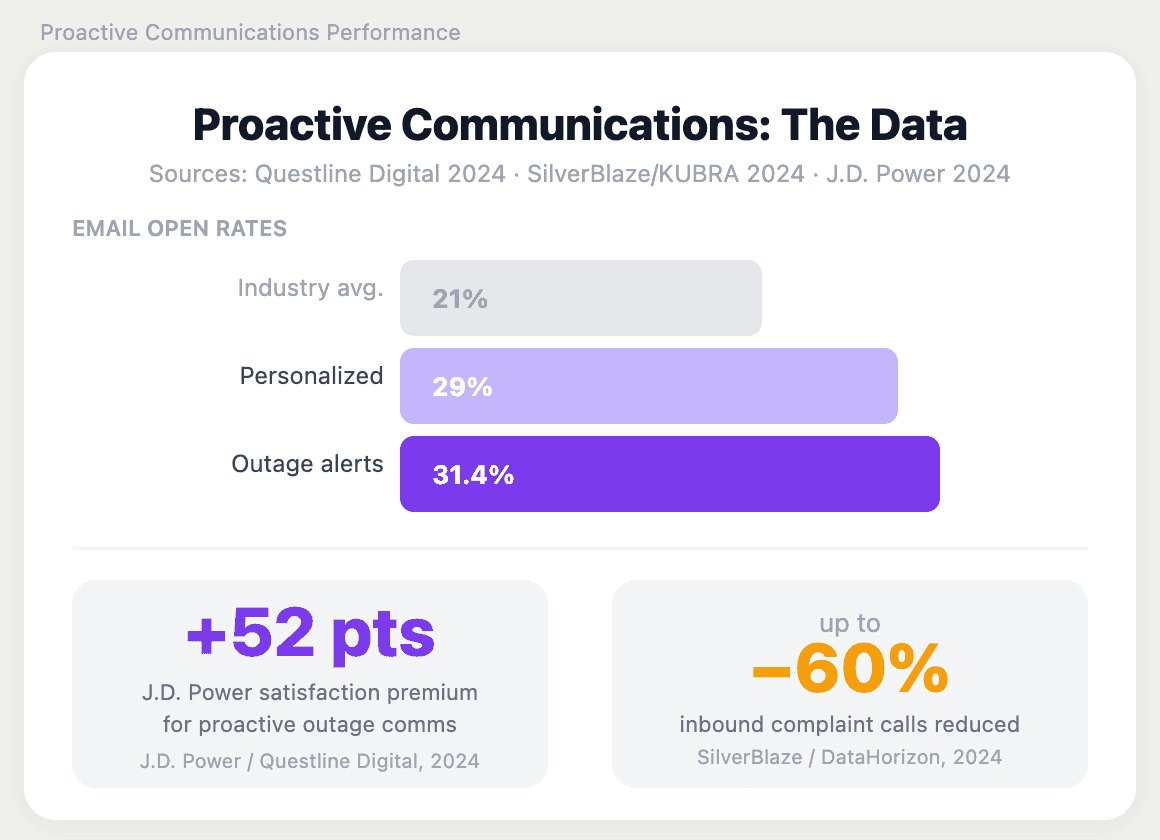
Utilities that provide timely outage information score an average of 52 points higher on J.D. Power's satisfaction scale than those that don't. That's not a marginal improvement — on a 1,000-point scale, 52 points is the difference between landing in the bottom quartile and sitting in the middle of the pack.
The data makes the case clearly. What the data can't fully capture is the segment-level variation in what that communication needs to say.
Three Customers. Same Platform. Entirely Different Messages.
The 120+ campaigns we've built for our California utility client aren't variations on a single template. They reflect a recognition that the utility's customer base is not a homogeneous audience — and that treating it as one produces communications that are technically sent but not genuinely received.
Three illustrative segments, and what each one actually needs:
Residential customers on time-of-use rates
Time-of-use (TOU) pricing shifts electricity costs based on when power is consumed. For a residential customer newly enrolled in a TOU plan, the communication need is educational: what does on-peak vs. off-peak mean for their bill? When should they run the dishwasher? How do they read their new statement?
These customers aren't in immediate danger. They're navigating a pricing model that's genuinely counterintuitive at first. The journey is longer, the content is more explanatory, and the call to action is behavioral — shift usage, not call the hotline.
What we've found in building these campaigns: the first 90 days after TOU enrolment are where call volume risk concentrates. If a customer doesn't understand their first bill under the new tariff, they call. Getting ahead of that moment with a well-timed, well-segmented explanatory sequence isn't just a customer satisfaction investment — it's measurable call deflection.
Small business owners facing planned outages
A small business owner's relationship with their power supply is commercial. A planned outage during business hours isn't an inconvenience — it's revenue impact, potential food safety exposure, and operational disruption.
The communication this customer needs is operational: exact timing, duration estimates, available resources, and the notification channels they should monitor. They also need to know what protections and compensation mechanisms apply, if any. A residential-grade outage notification lands as noise for this audience. An operationally-specific, business-aware communication lands as evidence that the utility sees them as a commercial relationship worth respecting.
Families in high fire-risk zones
This is the highest-stakes segment. A family in a designated High Fire-Risk Zone receiving a PSPS notification needs something different from a standard outage alert. They need to know whether this is a planned event or emergency shut-off, the anticipated duration, what medical baseline provisions cover, where Community Resource Centers are operating, and — critically — when power will be restored and how they'll be notified.
Segmented or not, every utility sends these notifications. The difference is whether they arrive as a mass blast that feels generic, or as a communication that reflects the specific conditions of that customer's location, risk profile, and household situation.
The Infrastructure Behind It: What Marketing + Data + Technology as One Team Produces
Segmented utility communications at this scale — millions of customers, 120+ campaigns, multiple customer types and regulatory contexts — aren't achievable when marketing, data, and technology operate as separate workstreams.
The segmentation logic requires data. The data needs to be structured against the right taxonomy to power the right message variant. The platform executing the send needs to be configured to surface the right content at the right moment, not just the right time. And the measurement framework — which sends are reducing call volume, which segments are showing re-engagement — needs to be built in from the start, not assembled after the fact.
When those three capabilities live in separate teams, with separate reporting lines and separate definitions of what success looks like, the ambition of personalized communications consistently exceeds the infrastructure's ability to deliver it. The segmentation plan exists. The data exists. The platform exists. But they don't talk to each other quickly enough or precisely enough to make the experience feel genuinely personal.
What we've observed across campaigns: The highest-performing communications we've built for utilities aren't necessarily the most technically complex. They're the ones where the data model, the content strategy, and the send logic were designed together from the start — where the question "what does this customer need to know?" was answered before "what does the platform support?" The sequence matters. When technology leads and content follows, you end up with what the system can do. When content and data lead together, you end up with what the customer actually needs.
In 2025, 55% of utility customers nationally experienced a power outage — and for business customers, that figure reached 74%, with Southern region businesses averaging 22 hours for their longest outage (J.D. Power, 2025 Electric Utility Business Customer Satisfaction Study). At that scale of disruption, the margin for a communication that doesn't land — because it was generic, mistimed, or sent to the wrong segment — isn't just a missed engagement metric. It's a customer who made a decision about their relationship with their utility provider in the middle of a crisis.
Want to rethink how your utility communicates with customers?
Why Are Your Customers Still Calling? The Case for Segmented Utility Communications
Most utility customers aren't calling because they enjoy it. They're calling because no one told them what was happening — and the digital experience they turned to first gave them nothing useful.
Utilities are consistently among the most call-intensive and queue-challenged industries in the country. The assumption is often that this is inevitable — that outages will always generate calls, that billing complexity will always require human intervention, that some customers will always prefer the phone. There's partial truth in all of that. But it misses the more important point: a significant share of utility call volume is predictable, preventable, and directly connected to the quality of proactive digital communications an organization sends before a customer ever picks up the phone.
We've been building those communications for a leading California investor-owned utility. The scope: more than 120 email campaigns built in Salesforce Marketing Cloud, reaching millions of Californians with personalized communications on energy choices, wildfire preparedness, and outage readiness. What we've learned in that work shapes how we think about utility customer communications more broadly.
Key Takeaways
In 2024, utility digital experience satisfaction scored just 594 out of 1,000 on J.D. Power's scale — the lowest of any major financial services or utilities category studied (J.D. Power, 2024)
Utilities that provide timely outage information score 52 points higher on customer satisfaction than those that don't (J.D. Power, via Questline Digital, 2024)
Proactive outage communications reduce inbound complaint call volumes by up to 60%, according to industry deployment data (SilverBlaze/DataHorizon, 2024)
In California, a single November 2024 PSPS event de-energized 71,044 SCE customers — and generic communications in that context aren't just a CX failure, they're a public safety failure (CPUC, 2024)
Utility Digital Experience Has a Satisfaction Problem
In 2024, overall utility residential customer satisfaction declined for the fourth consecutive year, reaching 707 out of 1,000 in J.D. Power's annual study — with billing and customer care posting the steepest drops (J.D. Power, 2024 U.S. Electric Utility Residential Customer Satisfaction Study, n=107,175 respondents, 151 utility brands). On the digital experience side, utilities scored 594 out of 1,000 — significantly below wealth management apps (718), property and casualty insurance (702), and retirement plans (685). Notably, 27% of utilities still don't offer a mobile app.
That number matters for a specific reason: when digital experience is poor, customers default to a more expensive channel. They call.
The relationship between digital quality and inbound call volume is more direct than most utility leaders account for. Industry deployment data suggests that proactive outage communications — the kind that reach customers before they start searching for answers — can reduce complaint call volumes by up to 60% during outage events (SilverBlaze, citing DataHorizon research, 2024). One KUBRA utility client saw an 18% reduction in inbound calls after implementing more proactive outage communication workflows, combined with a 77% increase in the volume of proactive notifications sent.
The inverse is also true: when customers aren't told what's happening, they find out by calling. Many times.
In California, Generic Communications Carry a Different Kind of Risk
Wildfire season, heat events, and grid stress are no longer seasonal concerns for California utilities — they're year-round operational realities. Public Safety Power Shutoff (PSPS) events, in which utilities proactively de-energise circuits to prevent ignition in high-risk weather conditions, have become a fixture of California life.
In November 2024 alone, SCE triggered a PSPS event that de-energized 71,044 customers across eight counties in a single action. The following month, a wind event simultaneously de-energized 51,105 SCE customers and 51,922 SDG&E customers (CPUC Post-Event Reports, 2024).
These aren't routine outages. A customer losing power because of planned grid maintenance needs information. A family in a high fire-risk zone losing power during a PSPS event — possibly with medical equipment, refrigerated medication, or elderly dependants in the household — needs a completely different communication. The timing is different. The content is different. The call to action is different.
The stakes shift when communications fail: A generic mass email sent 24 hours before a PSPS event might tell a residential customer their power will be out. It won't tell the small business owner which tariff provisions apply, what backup resources are available, or how to file for interruption credits. And it won't tell the family in a designated High Fire-Risk Zone what SCE's medical baseline program covers or where their nearest Community Resource Centers is. Same send. Three customers who needed three different messages. One of them — statistically — wasn't ready when it mattered.
SCE's grid hardening program is currently targeting 80,000 customers in high fire-risk zones across 60+ communities, with a projected 78% reduction in PSPS exposure for the most-impacted circuits (Energized by Edison, SCE, 2023). The infrastructure investment is significant. But the communications layer — what customers receive, when, and in what form — is what determines whether that investment translates into trust, or whether it lands as another mass notification that felt like it was written for someone else.
What Proactive Communications Actually Change
In 2024, Questline Digital's utility email benchmarks found that outage-related emails achieve a 31.4% open rate — the second-highest category in utility email performance, behind only welcome series (Questline Digital, 2024). Separately, 82% of utility customers say they prefer proactive communications during an outage over finding out through other means.
That 31.4% figure deserves some context. The average email marketing open rate across industries sits around 21%. Outage communications outperform that baseline by nearly 50% — because customers are actively looking for that information. The opportunity isn't getting people to care about the message. It's delivering the right message before they've had to go looking for it themselves.
Utilities that provide timely outage information score an average of 52 points higher on J.D. Power's satisfaction scale than those that don't. That's not a marginal improvement — on a 1,000-point scale, 52 points is the difference between landing in the bottom quartile and sitting in the middle of the pack.
The data makes the case clearly. What the data can't fully capture is the segment-level variation in what that communication needs to say.
Three Customers. Same Platform. Entirely Different Messages.
The 120+ campaigns we've built for our California utility client aren't variations on a single template. They reflect a recognition that the utility's customer base is not a homogeneous audience — and that treating it as one produces communications that are technically sent but not genuinely received.
Three illustrative segments, and what each one actually needs:
Residential customers on time-of-use rates
Time-of-use (TOU) pricing shifts electricity costs based on when power is consumed. For a residential customer newly enrolled in a TOU plan, the communication need is educational: what does on-peak vs. off-peak mean for their bill? When should they run the dishwasher? How do they read their new statement?
These customers aren't in immediate danger. They're navigating a pricing model that's genuinely counterintuitive at first. The journey is longer, the content is more explanatory, and the call to action is behavioral — shift usage, not call the hotline.
What we've found in building these campaigns: the first 90 days after TOU enrolment are where call volume risk concentrates. If a customer doesn't understand their first bill under the new tariff, they call. Getting ahead of that moment with a well-timed, well-segmented explanatory sequence isn't just a customer satisfaction investment — it's measurable call deflection.
Small business owners facing planned outages
A small business owner's relationship with their power supply is commercial. A planned outage during business hours isn't an inconvenience — it's revenue impact, potential food safety exposure, and operational disruption.
The communication this customer needs is operational: exact timing, duration estimates, available resources, and the notification channels they should monitor. They also need to know what protections and compensation mechanisms apply, if any. A residential-grade outage notification lands as noise for this audience. An operationally-specific, business-aware communication lands as evidence that the utility sees them as a commercial relationship worth respecting.
Families in high fire-risk zones
This is the highest-stakes segment. A family in a designated High Fire-Risk Zone receiving a PSPS notification needs something different from a standard outage alert. They need to know whether this is a planned event or emergency shut-off, the anticipated duration, what medical baseline provisions cover, where Community Resource Centers are operating, and — critically — when power will be restored and how they'll be notified.
Segmented or not, every utility sends these notifications. The difference is whether they arrive as a mass blast that feels generic, or as a communication that reflects the specific conditions of that customer's location, risk profile, and household situation.
The Infrastructure Behind It: What Marketing + Data + Technology as One Team Produces
Segmented utility communications at this scale — millions of customers, 120+ campaigns, multiple customer types and regulatory contexts — aren't achievable when marketing, data, and technology operate as separate workstreams.
The segmentation logic requires data. The data needs to be structured against the right taxonomy to power the right message variant. The platform executing the send needs to be configured to surface the right content at the right moment, not just the right time. And the measurement framework — which sends are reducing call volume, which segments are showing re-engagement — needs to be built in from the start, not assembled after the fact.
When those three capabilities live in separate teams, with separate reporting lines and separate definitions of what success looks like, the ambition of personalized communications consistently exceeds the infrastructure's ability to deliver it. The segmentation plan exists. The data exists. The platform exists. But they don't talk to each other quickly enough or precisely enough to make the experience feel genuinely personal.
What we've observed across campaigns: The highest-performing communications we've built for utilities aren't necessarily the most technically complex. They're the ones where the data model, the content strategy, and the send logic were designed together from the start — where the question "what does this customer need to know?" was answered before "what does the platform support?" The sequence matters. When technology leads and content follows, you end up with what the system can do. When content and data lead together, you end up with what the customer actually needs.
In 2025, 55% of utility customers nationally experienced a power outage — and for business customers, that figure reached 74%, with Southern region businesses averaging 22 hours for their longest outage (J.D. Power, 2025 Electric Utility Business Customer Satisfaction Study). At that scale of disruption, the margin for a communication that doesn't land — because it was generic, mistimed, or sent to the wrong segment — isn't just a missed engagement metric. It's a customer who made a decision about their relationship with their utility provider in the middle of a crisis.
Want to rethink how your utility communicates with customers?
SOURCES
J.D. Power, 2024 U.S. Electric Utility Residential Customer Satisfaction Study, retrieved 2026-05-05, https://www.jdpower.com/business/press-releases/2024-us-electric-utility-residential-customer-satisfaction-study
J.D. Power, 2024 U.S. Utility Digital Experience Study, retrieved 2026-05-05, https://www.jdpower.com/business/press-releases/2024-us-utility-digital-experience-study
J.D. Power, 2025 Electric Utility Business Customer Satisfaction Study, retrieved 2026-05-05, https://www.jdpower.com/business/press-releases/2025-electric-utility-business-customer-satisfaction-study
Questline Digital, Outage Communications Boosts Customer Satisfaction, 2024, retrieved 2026-05-05, https://www.questline.com/blog/outage-communications-improve-customer-satisfaction/
SilverBlaze, Outage Management Systems Explained, 2024, retrieved 2026-05-05, https://www.silverblaze.com/blog/outage-management-systems-explained/
KUBRA, 7 Effective Strategies to Reduce Call Center Volume for Utilities, 2024, retrieved 2026-05-05, https://www.kubra.com/blog/7-effective-strategies-to-reduce-call-center-volume-for-utilities
Convey, The Future of Utility Communications: 2025 Outlook, 2025, retrieved 2026-05-05, https://www.goconvey.com/future-of-utility-communications-2025/
CPUC, Public Safety Power Shutoffs — Post-Event Reports, 2024, retrieved 2026-05-05, https://www.cpuc.ca.gov/consumer-support/psps/utility-company-psps-reports-post-event-and-post-season
SCE / Energized by Edison, SCE Expedites Grid Hardening to Reduce PSPS, 2023, retrieved 2026-05-05, https://energized.edison.com/stories/sce-expedites-grid-hardening-to-reduce-psps
DemandSage, 89 Email Marketing Statistics of 2026, 2025, retrieved 2026-05-05, https://www.demandsage.com/email-marketing-statistics/
American Public Power Association, Emergency Communications Evolution, 2024, retrieved 2026-05-05, https://www.publicpower.org/periodical/article/emergency-communications-evolution-how-intelligent-workflows-are-reshaping-utility-crisis-response
WORK WITH US
Innovation starts with collaboration
WORK WITH US
Innovation starts with collaboration
WORK WITH US
Innovation starts with collaboration
Insights